Episode · from the 1930s to the 1970s · The emptying
The hearth, school and the road to Valencia
The memoirs published by Tu Comarca magazine show what growing up in Tragacete and Vega del Codorno was like through much of the 20th century. Homes were lit with resinous splinters in holders, evenings were spent in gatherings round the fire and children played cochineta and gua with apricot stones. Firewood was taken to school, and families helped one another at the pig slaughter. During the war people fled to caves, and afterwards many young women went into service in Madrid and Valencia.
On this page 9 sections
The hearth fire
The house was lit with resinous wood splinters. They were placed in almenaras, holders: some tall, tripod-shaped, with slots to hold them, and others with a handle, fixed beside the fireplace. To move round the house people used the oil lamp, with oil and a wick. In the hearth, firedogs supported the wood, and cauldrons hung from the pot chain, an iron chain. In a house in Vega del Codorno remembered by Ana Maeso, potatoes and chickpeas were roasted in the ashes.
In winter there were trasnochadas, evening gatherings, at relatives’ and neighbours’ homes. Beans were shelled beside the fire, cards played and stories told. In summer chairs were taken outside the door, and sewing was done in the street to use the light. When television arrived, anyone without a set went to a neighbour’s house or the bar. In Tragacete, Pilar Muñoz went to Bar Yuste to watch the Familia Telerín. Sets were bought in instalments, with bills of exchange.
The women of Tragacete also remembered what they ate:
- gachas with liver, a flour-based porridge at pig-slaughter time, though there was not always liver;
- chickpea stew with garlic and paprika, nothing more, unlike today’s;
- patatas tostadas, potatoes boiled then cooked in a frying pan over the fire with oil, garlic and paprika until the liquid was gone;
- bread and milk soup, sweetened with honey when there was no sugar.
The games
In June 2023 the women of Tragacete remembered their childhood games: gua, mincho, tejo and knucklebones. Pilar Muñoz has added others:
- cochineta, with a ball and boxwood stick;
- in skipping, tocinete, speeding up the rope when someone kept jumping for a long time;
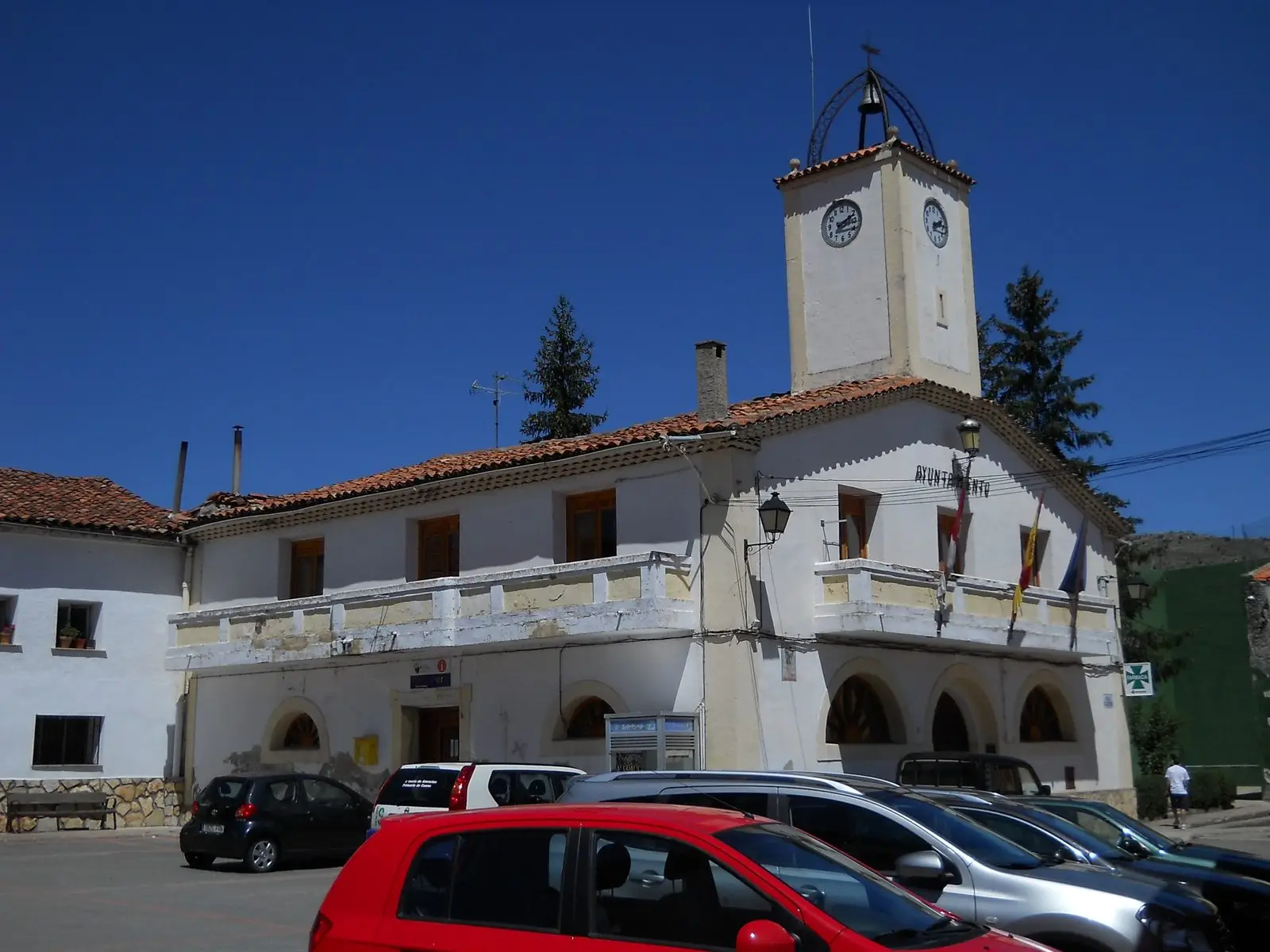
- maya, a kind of hide-and-seek: players had to reach a stone on the window of the old town hall, today’s tourist office, before the seeker, freeing the others;
- gua, played in the sand of the square with apricot stones, the cucos, kept when the fruit arrived;
- iron hoops made by the blacksmith, guided with a hook;
- tomato tins dragged with a stick down to the river as if they were a flock;
- on the threshing floors, goals made with sticks and nets of agave fibre and twine, put up for games and taken down afterwards.
The school
Each child brought firewood or resinous splinters to Tragacete’s school for the stove, until the town council began providing fuel for the whole school year. Bottled milk was handed out at break time; before that, according to accounts, it had been powdered milk. Infants were taught together, and in the first year boys and girls were separated, joining again in the fourth. Two afternoons a week girls returned to the girls’ school for sewing. In the boys’ school garden there were four or five vegetable plots, each belonging to a group, and pupils also tended the school woodland plot, which later became the Parque del Coto. In May, attending the rosary and May songs earned marks in Religious Education.
Not everyone got that far. A shepherd from Huélamo interviewed in 2019 went to school for just one year, with the teacher Nicolás, in the building now used as the town hall: boys upstairs and girls below. Ana Maeso remembers a relative who began shepherding at nine, with ten sheep and a goat.
The pig slaughter and harvest
The matanza, the annual pig slaughter, took place in November and December. One or two piglets were bought in spring and raised at home on produce from the vegetable plot. Their food was boiled in a cauldron on the small stove until bottled gas arrived. Neighbours helped on slaughter day and were later sent a presente, a gift of meat; the help was returned when another family held its slaughter. The magra del matador, a piece of lean pork, was reserved for the slaughterman. Chorizos were made with a machine with a crank, blades and funnels, and blood sausages with a wooden device with a large funnel. Children turned the crank and tied them.
At harvest, grain was stored in the attic in atrojes, partitioned compartments for each kind. Straw was hoisted from the street to the hayloft in a sheet with its four corners tied.
Visiting trades
Pilar Muñoz remembers three trades passing through the village:
- The barber. Her father set up in Tragacete’s square around 1945 and lived solely from barbering until the 1970s. Payment was through igualas, annual agreements: a whole year’s shaves and haircuts were paid for once, in grain from the harvest, though also in eggs or money, and debts were recorded in a notebook. A numbered board set the turns. Shaving water was heated on the small stove, and cologne was made there with rainwater and essences. Hours fitted shepherds and farmers leaving before dawn or returning at night. According to what she was told, besides the news bulletin they listened to La Pirenaica when no customer remained whom they distrusted.
- The town crier. He gave notice with a small trumpet. One or two blasts announced traders arriving on no fixed day and setting up in the square. Three blasts called for attention to a town council proclamation, a payment collection or dog vaccinations.
- The itinerants. A pair of travelling repairers carried their home and workshop in a cart. Villagers kept broken plates, water jugs, earthenware jars and saucepans until they returned, and they stayed while there was work. The knife grinder arrived by bicycle playing the chiflo, a small pipe, and was said to bring rain.
The war
During the bombing, Tragacete families sought shelter. A woman born in the 1920s remembered going into the Cueva del Estiércol with the animals and later spending periods near El Hosquillo and in Arcos de la Sierra. Another, born in the early 1930s, went by donkey to a house outside the village and ended up evacuated to Perona. A third, born in 1925, went with her family to the San Clemente area, and later they returned.
The road to Valencia
After the war many young women went into domestic service. One left as a teenager for a live-in job in Madrid and worked as a nanny, maid and cook. Another served in Valencia and returned for San Miguel by train and on the bus they called La Catalana. In the early 1960s she moved to Valencia again, now with her family: her husband joined a metal factory and she worked in private homes. She had gone down with her family to winter with livestock in Dos Aguas, and her family had looked after the Herrería power station in Vega del Codorno for three years and the Chorrera mill’s station for one. A third woman remembered working in Valencia with friends from the village. The women recalling games in 2023 had also left at fourteen, on finishing school, and returned in summer.
These are the memories of a few families, not the history of the whole village. The men’s transhumance is told in Shepherds of the Serranía, and what remained afterwards in The Serranía in the 21st century.
Vocabulary
- Almenara
- A holder for the resinous splinters used to light the house: one tall, on a tripod, and another with a handle fixed beside the fireplace.
- Llares
- An iron chain hanging in the fireplace to hold cauldrons over the fire.
- Morillos
- Irons supporting firewood in the hearth.
- Trasnochada
- A winter evening gathering in relatives' or neighbours' homes, beside the fire.
- Iguala
- An annual agreement with the barber (or doctor): the whole year's services were paid for in one go, in grain from the harvest.
- Atroje
- A partitioned compartment in the attic where each kind of grain was stored.
- Cucos
- Apricot stones kept for playing gua.
- Magra del matador
- The piece of pork reserved for the slaughterman.
Where it is today
Frequently asked questions
What did children in Tragacete play?
Girls played gua, mincho, tejo and knucklebones. Also cochineta, with a ball and boxwood stick; skipping, where tocinete meant speeding up the rope; and maya, a kind of hide-and-seek. They also rolled iron hoops made by the blacksmith and dragged tins, pretending they were flocks.
Where did they go to work?
Young women went into live-in domestic service in Madrid and Valencia, as nannies, maids or cooks. In the early 1960s whole families moved to Valencia: men to factories and women to private homes. They returned for San Miguel by train and on a bus they called La Catalana.
Sources and reading
- Método Móvil y La Circular: «Diálogo entre mujeres de Tragacete y estudiantes de Método Móvil», vídeo (01-07-2023), transcripción de YouTube, 00:06-03:16 source consulted
- Muñoz, P.: «Alumbrando el pasado», Tu Comarca 24 (abril de 2025), p. 4 source consulted
- Muñoz, P.: trasnochadas y televisión, Tu Comarca 18 (octubre de 2024), p. 3 source consulted
- Maeso, A.: memoria familiar, Tu Comarca 25 (mayo de 2025), pp. 3-5 source consulted
- Muñoz, P.: «Los juegos», Tu Comarca 38 (junio de 2026), pp. 5-7 source consulted
- La Circular: «Diálogo entre mujeres de Tragacete y estudiantes de Método Móvil» (18-06-2023) source consulted
- Muñoz, P.: la escuela de Tragacete, Tu Comarca 12 (abril de 2024), pp. 4-6 source consulted
- Muñoz, P.: la Cruz de mayo, Tu Comarca 13 (mayo de 2024), pp. 7-8 source consulted
- Liberal de Castilla: entrevista a un pastor de Huélamo (2019), reproducida en Tu Comarca 13 (mayo de 2024), pp. 11-16 source consulted
- Muñoz, P.: la matanza, Tu Comarca 31 (noviembre de 2025), pp. 19-22 source consulted
- Muñoz, P.: la cosecha, Tu Comarca 15 (julio de 2024), pp. 3-4 source consulted
- Muñoz, P.: «La barbería», Tu Comarca 32 (diciembre de 2025), pp. 14-16 source consulted
- Muñoz, P.: el pregonero, Tu Comarca 23 (marzo de 2025), p. 3 source consulted
- Muñoz, P.: oficios antiguos, Tu Comarca 37 (mayo de 2026), pp. 5-6 source consulted
- Recuerdos de una vecina de Tragacete nacida en 1925, Tu Comarca 26 (junio de 2025), p. 7 source consulted
- Entrevista de 2022 a una vecina de Tragacete, Tu Comarca 15 (julio de 2024), pp. 5-6 source consulted
- Entrevista a una vecina de Tragacete nacida en los años veinte, Tu Comarca 14 (junio de 2024), pp. 4-7 source consulted
Open questions
- The 2023 discussion mentions a coffee made with barley and beetroot; the automatic transcript does not make clear how it was made.
- The teacher Nicolás remembered by the Huélamo shepherd in 2019: the press documents a Nicolás Moreno Rabal in Huélamo between 1906 and 1917; given the shepherd's age, it may be a different teacher. The service record is missing.
- The memoirs do not date each stage: Pilar Muñoz's childhood, those of the women interviewed and school changes have no precise year.
- The Tragacete 109 podcasts and the video of the 2023 discussion have not yet been heard; they may add to the games and departures.
- The Casa de Don Casildo was used as barracks during the war, according to accounts heard; there is no date or document.