Archaeological site · Villar de Domingo García
Roman villa of Noheda
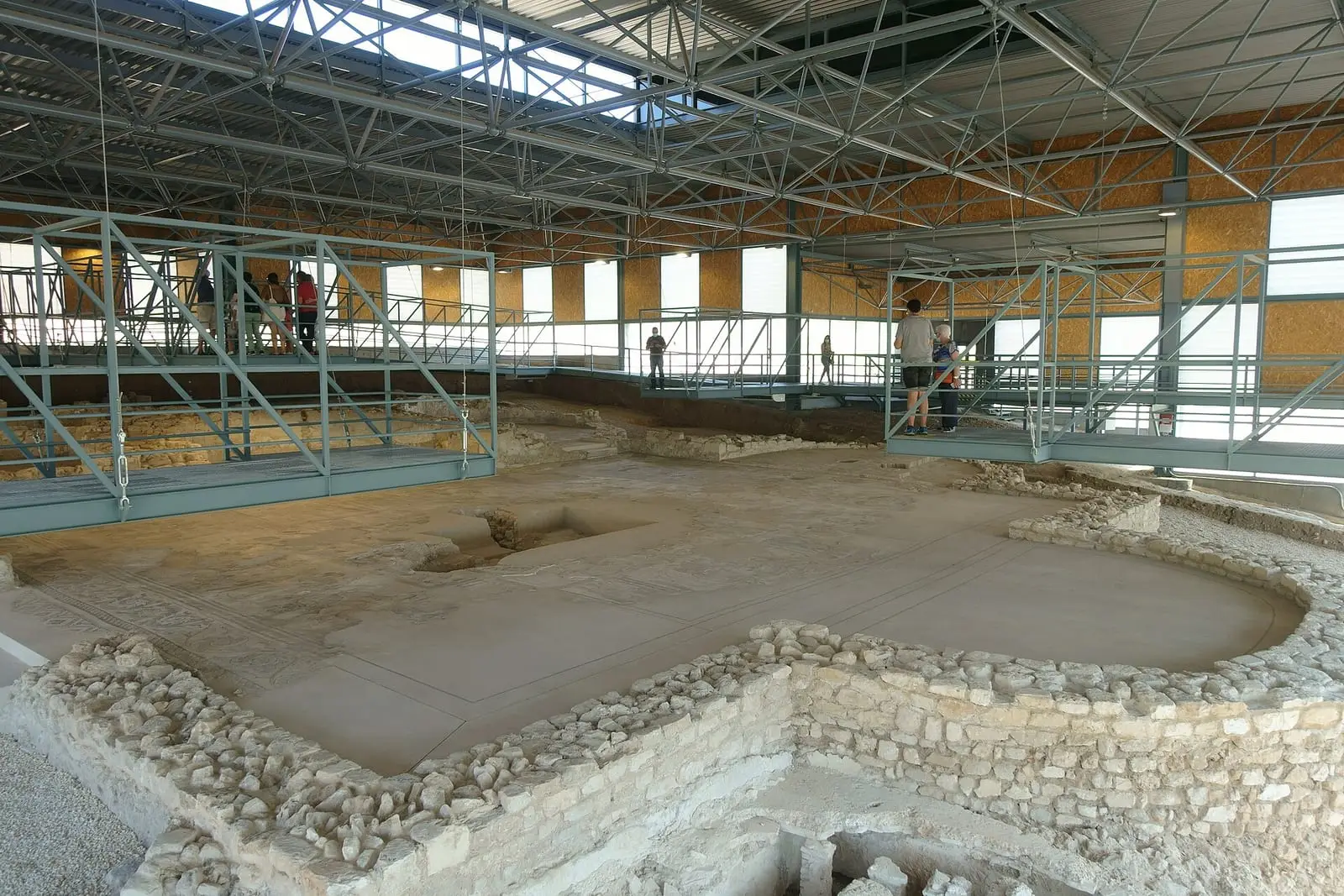
The Roman villa of Noheda lies around 500 m north-west of the dependent village of Noheda, in Villar de Domingo García. The regional Department of Culture dates it from the 1st century BC to the 6th century AD and describes a surviving figurative mosaic of 231.62 m². In 2020, 420 glass tesserae from the mosaic were analysed.
- Municipality
- Villar de Domingo García
- Roman villa
- Mosaic
- Noheda
- Tesserae
A villa in the Cuenca countryside
The villa of Noheda lies around 500 metres from the dependent village giving it its name, in Villar de Domingo García, around 18 km from Cuenca. It was inhabited between the 1st century BC and the 6th century AD. It has been a Bien de Interés Cultural (Spain’s highest heritage listing) since 2012.
The mosaic
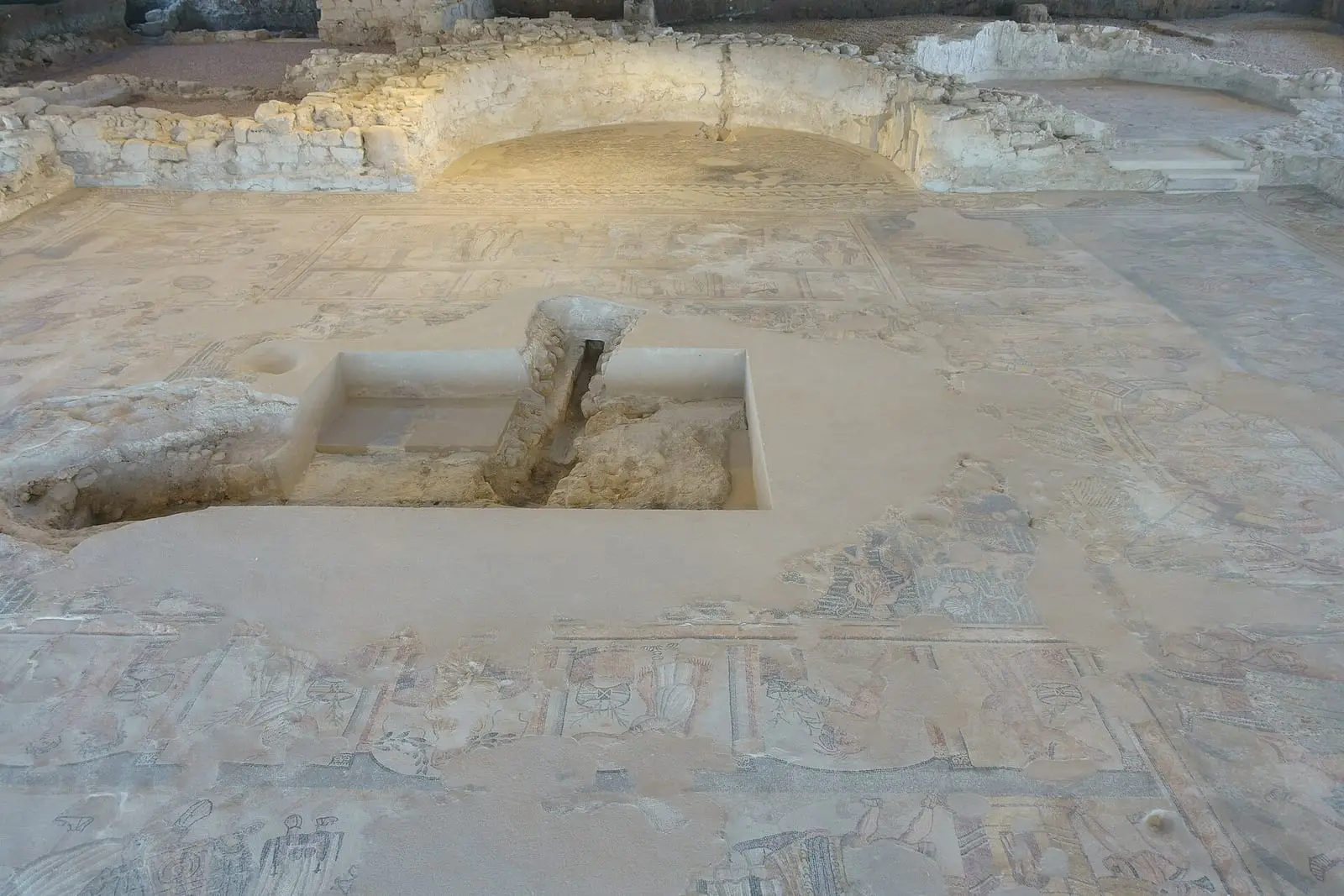
It lies in a square room of 290 m² with three exedras, the triclinium, or formal dining room. 231 m² of mosaic survive, almost entirely of tiny tesserae, with figurative scenes; the visitor guide refers to around 260 m² of flooring, and other sources to more than 300: they measure different things. Its tesserae include recycled Roman glass and some pieces made from Egyptian raw materials. The eastern apse has two superimposed 4th-century mosaics, reflecting a change in taste, and the room’s centre is sunken and blackened by a 5th-century fire that brought down the roof and dome.
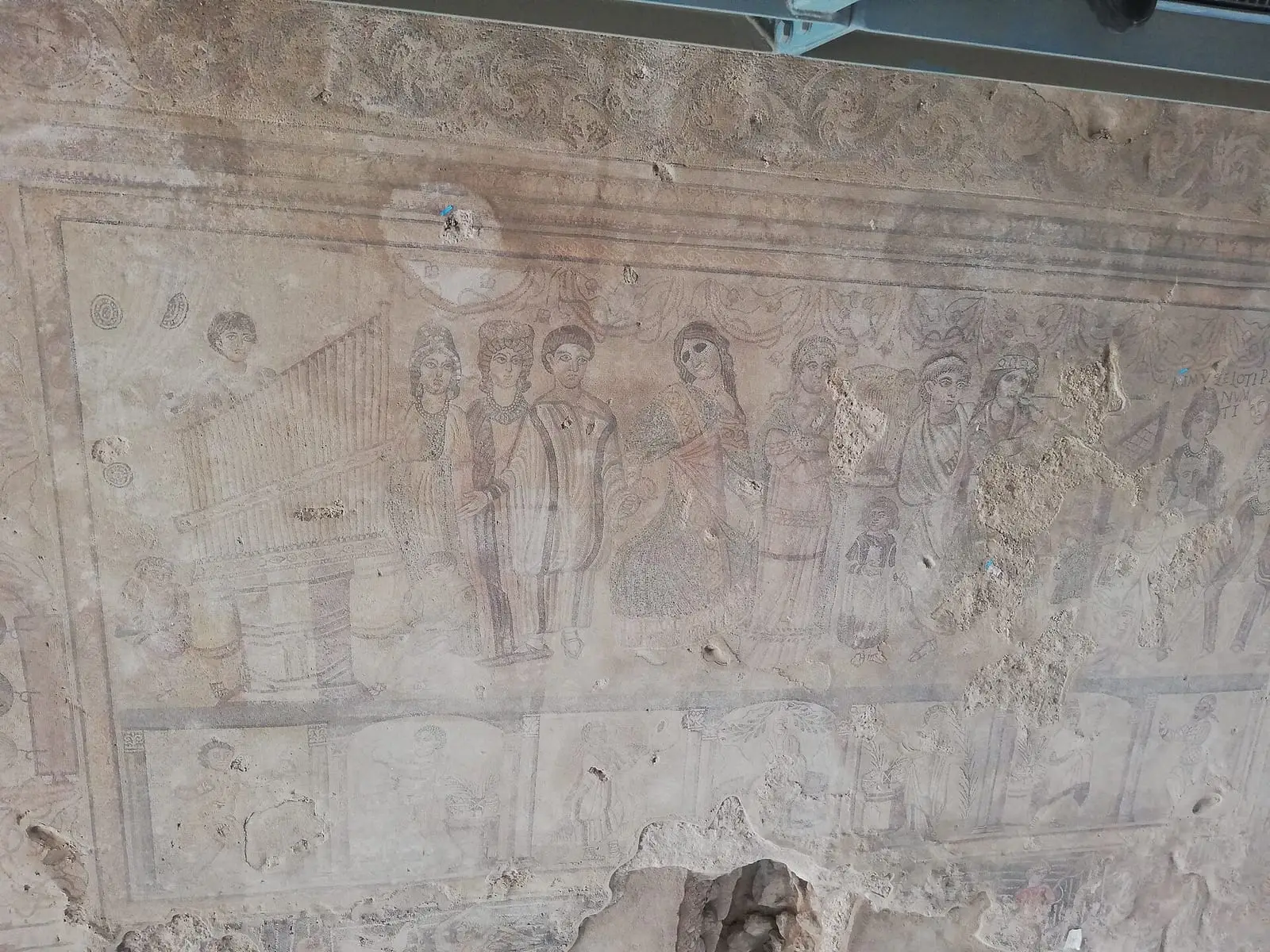
The floor reads like a comic strip in five panels. Facing the entrance, over almost ten metres, is the myth of Pelops and Hippodamia, a very rare depiction: King Oenomaus, with the heads of defeated suitors hanging up, challenges Pelops to a chariot race; Pelops bribes the king’s charioteer, the royal chariot’s wheels fly off and Pelops receives the palm of victory beside Hippodamia. The next scene, the betrayal of the charioteer, has been lost. There is also a pantomime with a water organ, lyre and aulos players and a masked actor; the procession of Dionysus and Ariadne, with musician centaurs and Silenus on a donkey; and the judgement of Paris, with the golden apple, the abduction of Helen and the ship towards Troy before a burning city. The villa owner’s name is unknown: no inscription naming him has appeared.
The rest of the villa
- The reception hall, discovered in 2018, covers more than 850 m², with a cruciform plan and a large exedra. It may be the largest room of its type in villas of the western Empire. Its walls, 1.20 m thick, survive in places to three metres high, with paintings. Its function remains disputed: the excavation director considers the possibility of a storehouse or production space, but favours a room where the owner received and selected visitors before they entered the dining room; research continued in 2026 because it had different uses.
- The baths, almost 900 m² and symmetrical, larger than the public baths of Segóbriga or Ercávica: changing rooms, a cold room with an exedra, a warm room, a massage room, bathtubs and a heated outdoor pool. Beneath the cold room run drainage galleries almost a hundred metres long and one metre high. They have been covered and their volume reconstructed with a steel mesh outlining arches and spaces.
- The villa occupies three terraces on the slope. Ground-penetrating radar indicates a western entrance with towers and a large courtyard with porticoes distributing access to the rooms; on the lower terrace were six large stepped pools, around thirteen by six metres, with channels beneath the rooms to irrigate the garden.
- The agricultural area to the north, badly damaged: ploughing has reached the foundations.
In 2023 an estimated 5% of the villa had been excavated, and in 2026 around 7%. The radio has given the whole site’s area as ten hectares in an interview and a hundred in an article; the surveyed municipal plot measures 4.75. Archaeologists, conservators, university students, around fifty secondary-school pupils and a training and employment programme group restoring the pools worked in the 2026 field season. Its director also wants to study those who worked for the owner, the least visible people.
During the 2024 field season, a UCLM team led by Miguel Ángel Valero, with secondary-school pupils, removed mud from the pool drains by the bucketful and sieved it by layer: fragments of opus sectile, marble-slab cladding, and many tesserae emerged. They were seeking a coin or pottery fragment that would date the end of the baths’ use; none had been found. Valero places construction of the great hall in the 4th century, its collapse in the late 5th and subsequent reoccupation, with adult and child graves over the rubble, in the 5th and 6th centuries. He attributes the marbles to around thirty quarries across the Mediterranean, in Egypt, Turkey, Tunisia and Italy, as evidence of the power of great late Roman landowners; the villa owner’s name remains unknown. His drain dimensions, around 50 by 80 centimetres, differ from the one-metre height in other sources.
Plan your visit
Book through the regional government of Castilla-La Mancha’s culture portal. There is an interpretation centre in the village and a building protecting the mosaics.
Before you travel
Check opening times and prices before going.
Combine with
The village, under Villar de Domingo García.


Frequently asked questions
What did the glass analysis show?
That it is mainly recycled Roman mixed-base glass, indicating that reuse was common in the 4th century, with a subset consistent with Egyptian raw materials.
Can it be visited?
We have not located access conditions in official sources.
Carry on from here
This place through time
Which eras you can read here
A single place can keep traces of several periods. These layers connect what you see with the atlas's stories.
Where it is
● Reference point · ● Villages · ● Places · ━ Routes nearby
Location sketch. The map with paths and names loads as you scroll to it.
Reference villages: Villar de Domingo García · Sotorribas · Mariana · Zarzuela.
Open the full map and its historical layers →Where the data on this page come from
- Name
- Rewilding España source consulted, 4 October 2026
- «Villa Romana de Noheda» source consulted
- Location
- Rewilding España source consulted, 4 October 2026
- Municipality (INE code)
- «Villa Romana de Noheda» source consulted
«Source consulted»: the primary source has been read. «Reference located»: the source has been identified but not yet read. «Open question»: the figure needs confirmation.