Trade · 20th century · The trades of the forest and the water
Plants with names: the ethnobotany of the Serranía
At the end of the 20th century a team of botanists visited 41 villages in the Serranía Alta and Baja, asking older men and women about plants. The book Etnobotánica en la Serranía de Cuenca (2003) records names that change from village to village and uses for food, curdling milk, seasoning, caring for people and animals, sweeping, weaving, playing and protection against the evil eye. These are memories of uses, not recipes.
On this page 7 sections
A book of voices
At the end of the 20th century the botanists José Fajardo, Alonso Verde, Diego Rivera and Concepción Obón visited 41 villages in the Serranía Alta (upper Serranía) and Serranía Baja (lower Serranía), asking those who knew the countryside best, many in their eighties or nineties. They cross-checked what they were told against the Relaciones de Felipe II, the Ensenada Cadastre and the dictionaries of Miñano and Madoz, and in 2003 Cuenca Provincial Council (Diputación de Cuenca) published the result: Etnobotánica en la Serranía de Cuenca. Las plantas y el hombre. Today it records memories that could no longer be gathered in the same way.
The first thing it shows is that plants have many names. Torvisco is also matapollos; savoury, morquera; marjoram, hierba del Señor. The same name may mean one plant in one village and another in the next.
Eating, curdling, healing
In spring people gathered collejas (bladder campion) and cardillos (edible thistles) for stews; fennel, thyme, rosemary and morquera were used for seasoning and dressing olives, and plants called cuajaleches were used to curdle milk for cheese. Grass peas, known as almortas or guijas, were grown even in the Serranía Alta.
Each place had its own remedies for colds, according to the book: fig and marsh-mallow syrup in Valdemeca, French lavender in Cañete and Boniches, rose hips in Vega del Codorno, rue in Fuentelespino de Moya and, in Huerta del Marquesado, an onion beside the bed. These are remembered uses, not proven remedies.
Belief and protection
Torvisco protected against the evil eye, particularly in the Serranía Baja. Asensio, an Artemisia, was hung in pigsties, and in Tejadillos people remember it being put up against a cholera epidemic. Marjoram and other plants provided proverbs and sayings.
Sweeping, carding, weaving
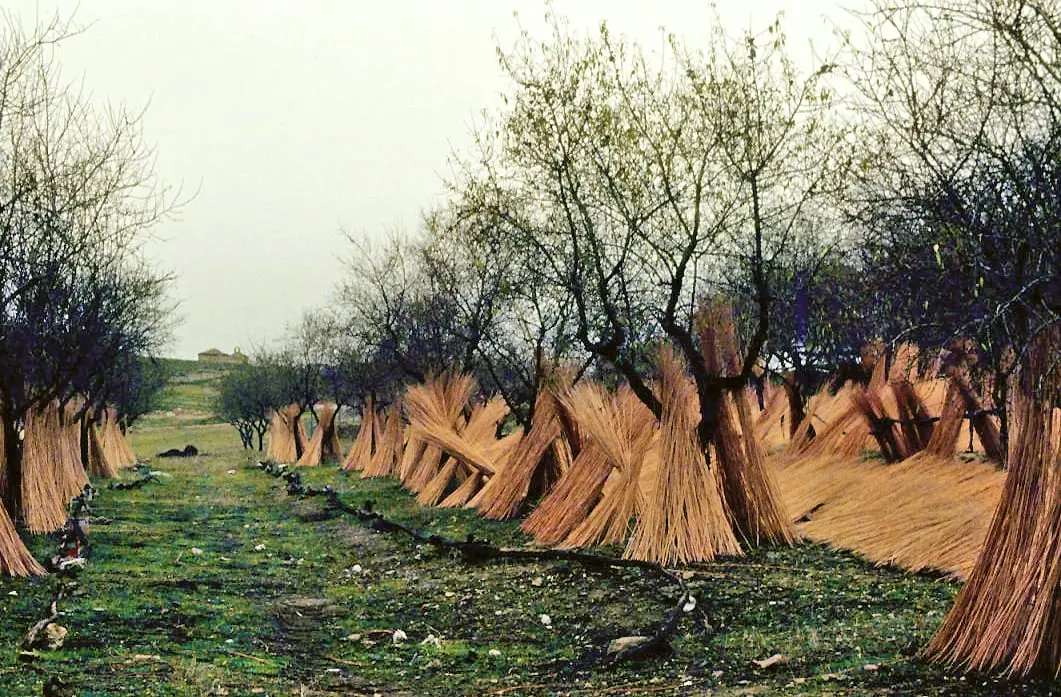
Plants were tools too. There were fine brooms for hearth ash, brooms of escoba amarga gathered in the countryside for threshing floors and stores, and large besoms. Cardo yesquero provided tinder, and the heads of the teasel were used to card wool. Willow, esparto and bulrush were woven into the containers later replaced by plastic. In Cañizares a workshop of women basketmakers worked with willow from the river valleys for almost twenty years from 1980, and in 2020 three of them began weaving together again.
From the archive
Words of the trade
- Etnobotánica
- The study of what people know and do with plants: not only remedies but also food, objects, games and beliefs.
- Torvisco o matapollos
- A shrub associated with protection against the evil eye in the Serranía Baja.
- Morquera o ajedrea
- An aromatic herb used to season olives and other food.
- Cuajaleches
- A name given to plants used to curdle milk when making cheese; it is not always the same species.
- Cardo cardador
- Teasel, whose heads were used to card wool.
- Asensio
- An Artemisia hung up for protection.
Where it is today
Frequently asked questions
Can these remedies be used?
They are not advice: the atlas records them as memories of what people did, not as treatments. The same popular name can refer to different plants, and some are toxic.
Where can the study be read?
The book Etnobotánica en la Serranía de Cuenca, by José Fajardo, Alonso Verde, Diego Rivera and Concepción Obón, was published by Cuenca Provincial Council (Diputación de Cuenca) in 2003.
Sources and reading
- Hoy por Hoy Cuenca, Cadena SER: «Plantas, saberes y territorio: el legado etnobotánico de la Serranía de Cuenca» (08-01-2026, con audio) source consulted · Interview about the 2003 book; the uses identified by village come from it.
- Hoy por Hoy Cuenca, Cadena SER: «Las plantas y sus usos: la etnobotánica en las tradiciones de Cuenca» (05-10-2022, con audio) source consulted
- Hoy por Hoy Cuenca, Cadena SER: «El mimbre como oficio y terapia para un grupo de mujeres del pueblo conquense de Cañizares» (15-06-2021, con audio) source consulted
- Fajardo, J., Verde, A., Rivera, D. y Obón, C. (2003): Etnobotánica en la Serranía de Cuenca. Las plantas y el hombre. Diputación de Cuenca reference located · Located; not read in full. Needed to establish species and localities.
Open questions
- Scientific names of each plant and list of the 41 villages in the study: these need to be taken from the book.
- The resolí from Zarzuela with té de río mentioned on the radio: the plants it contains have yet to be identified.